Jonathan Schmidt Jonathan Schmidt
  • Publications
  • Blog
Papers

Selected publications

A curated selection. The complete list lives on Google Scholar.

npj Climate and Atmospheric Science · 2025

A Generative Framework for Probabilistic, Spatiotemporally Coherent Downscaling of Climate Simulation

Jonathan Schmidt, Luca Schmidt, Felix Strnad, Nicole Ludwig, Philipp Hennig

Generative ModelsAtmospheric Science
Paper Code
Abstract

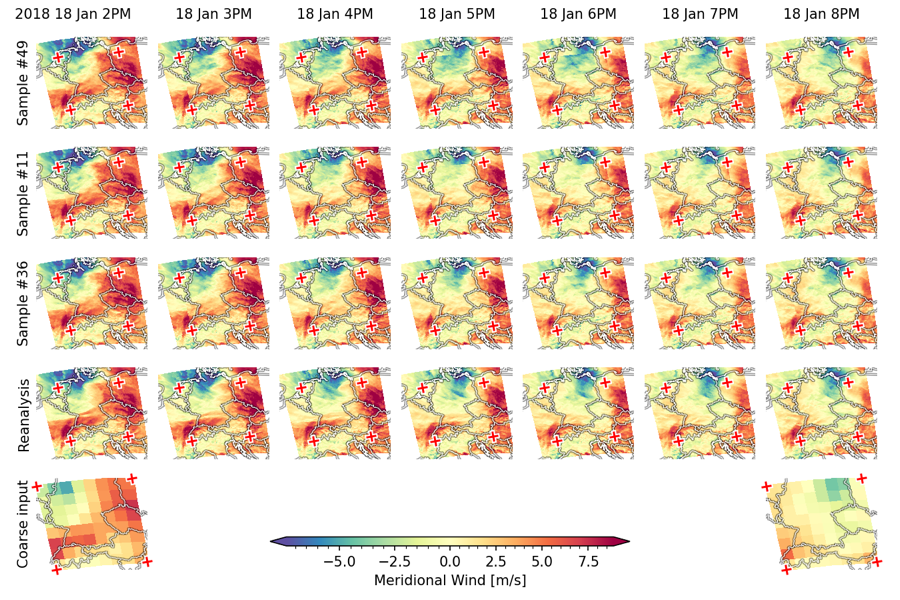
Generative diffusion model for downscaling climate simulations, focusing on spatiotemporal coherence and probabilistic inference.

NeurIPS · 2023

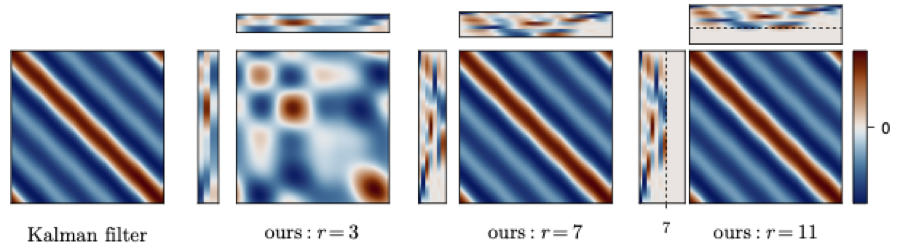
The Rank-Reduced Kalman Filter: Approximate Dynamical-Low-Rank Filtering in High Dimensions

Jonathan Schmidt, Philipp Hennig, Jörg Nick, Filip Tronarp

Bayesian FilteringLow-Rank Approximations
Paper Code
Abstract

Inference and simulation in the context of high-dimensional dynamical systems remain computationally challenging problems. Some form of dimensionality reduction is required to make the problem tractable in general. In this paper, we propose a novel approximate Gaussian filtering and smoothing method which propagates low-rank approximations of the covariance matrices. This is accomplished by projecting the Lyapunov equations associated with the prediction step to a manifold of low-rank matrices, which are then solved by a recently developed, numerically stable, dynamical low-rank integrator. Meanwhile, the update steps are made tractable by noting that the covariance update only transforms the column space of the covariance matrix, which is low-rank by construction. The algorithm differentiates itself from existing ensemble-based approaches in that the low-rank approximations of the covariance matrices are deterministic, rather than stochastic. Crucially, this enables the method to reproduce the exact Kalman filter as the low-rank dimension approaches the true dimensionality of the problem. Our method reduces computational complexity from cubic (for the Kalman filter) to quadratic in the state-space size in the worst-case, and can achieve linear complexity if the state-space model satisfies certain criteria. Through a set of experiments in classical data-assimilation and spatio-temporal regression, we show that the proposed method consistently outperforms the ensemble-based methods in terms of error in the mean and covariance with respect to the exact Kalman filter. This comes at no additional cost in terms of asymptotic computational complexity.

ICML · 2022

Probabilistic ODE Solutions in Millions of Dimensions

Nicholas Krämer, Nathanael Bosch, Jonathan Schmidt, Philipp Hennig

Probabilistic NumericsDynamical Systems
Paper Code
Abstract

Probabilistic solvers for ordinary differential equations (ODEs) have emerged as an efficient framework for uncertainty quantification and inference on dynamical systems. In this work, we explain the mathematical assumptions and detailed implementation schemes behind solving high-dimensional ODEs with a probabilistic numerical algorithm. This has not been possible before due to matrix-matrix operations in each solver step, but is crucial for scientifically relevant problems — most importantly, the solution of discretised partial differential equations. In a nutshell, efficient high-dimensional probabilistic ODE solutions build either on independence assumptions or on Kronecker structure in the prior model. We evaluate the resulting efficiency on a range of problems, including the probabilistic numerical simulation of a differential equation with millions of dimensions.

AISTATS · 2022

Probabilistic Numerical Method of Lines for Time-Dependent Partial Differential Equations

Nicholas Krämer, Jonathan Schmidt, Philipp Hennig

Probabilistic NumericsGaussian Processes
Paper Code
Abstract

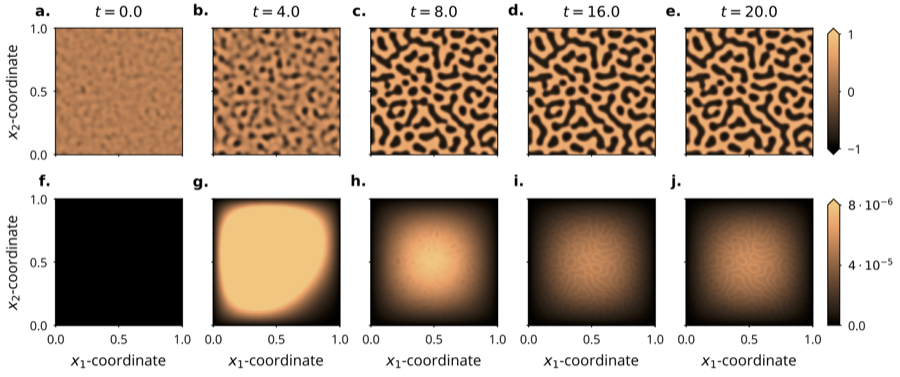
This work develops a class of probabilistic algorithms for the numerical solution of nonlinear, time-dependent partial differential equations (PDEs). Current state-of-the-art PDE solvers treat the space- and time-dimensions separately, serially, and with black-box algorithms, which obscures the interactions between spatial and temporal approximation errors and misguides the quantification of the overall error. To fix this issue, we introduce a probabilistic version of a technique called method of lines. The proposed algorithm begins with a Gaussian process interpretation of finite difference methods, which then interacts naturally with filtering-based probabilistic ordinary differential equation (ODE) solvers because they share a common language: Bayesian inference. Joint quantification of space- and time-uncertainty becomes possible without losing the performance benefits of well-tuned ODE solvers. Thereby, we extend the toolbox of probabilistic programs for differential equation simulation to PDEs.

NeurIPS · 2021

A Probabilistic State Space Model for Joint Inference from Differential Equations and Data

Jonathan Schmidt, Nicholas Krämer, Philipp Hennig

State-Space ModelsDynamical SystemsEpidemiology
Paper Code
Abstract

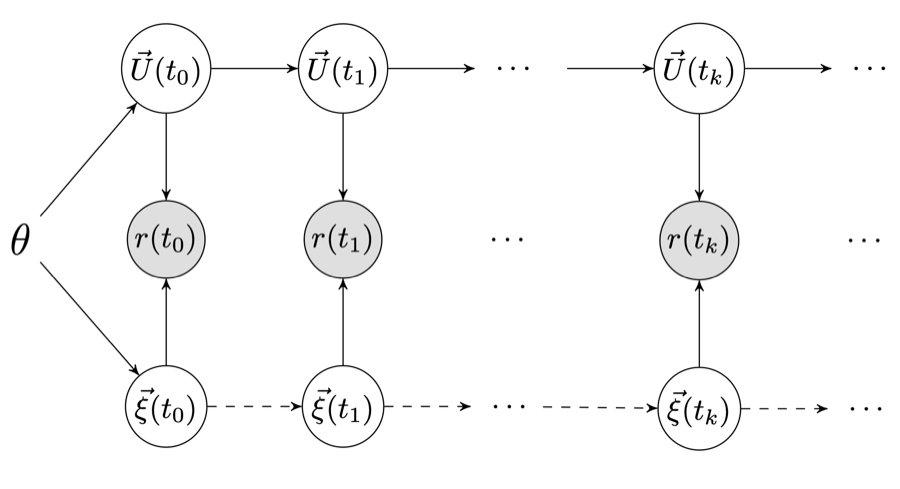
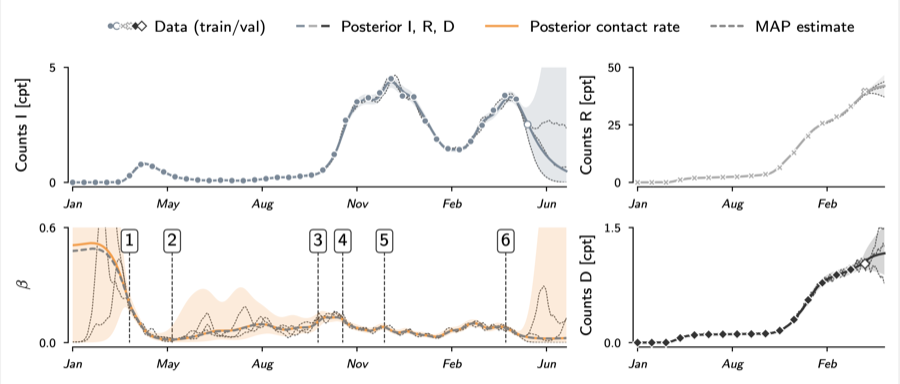
Mechanistic models with differential equations are a key component of scientific applications of machine learning. Inference in such models is usually computationally demanding because it involves repeatedly solving the differential equation. The main problem here is that the numerical solver is hard to combine with standard inference techniques. Recent work in probabilistic numerics has developed a new class of solvers for ordinary differential equations (ODEs) that phrase the solution process directly in terms of Bayesian filtering. We here show that this allows such methods to be combined very directly, with conceptual and numerical ease, with latent force models in the ODE itself. It then becomes possible to perform approximate Bayesian inference on the latent force as well as the ODE solution in a single, linear complexity pass of an extended Kalman filter / smoother — that is, at the cost of computing a single ODE solution. We demonstrate the expressiveness and performance of the algorithm by training, among others, a non-parametric SIRD model on data from the COVID-19 outbreak.

Preprint · 2021

ProbNum: Probabilistic Numerics in Python

Jonathan Wenger, Nicholas Krämer, Marvin Pförtner, Jonathan Schmidt, Nathanael Bosch, Nina Effenberger, Johannes Zenn, Alexandra Gessner, Toni Karvonen, François-Xavier Briol, Maren Mahsereci, Philipp Hennig

SoftwareProbabilistic NumericsGaussian Processes
Paper Code
Abstract

Probabilistic numerical methods (PNMs) solve numerical problems via probabilistic inference. They have been developed for linear algebra, optimization, integration and differential equation simulation. PNMs naturally incorporate prior information about a problem and quantify uncertainty due to finite computational resources as well as stochastic input. In this paper, we present ProbNum: a Python library providing state-of-the-art probabilistic numerical solvers. ProbNum enables custom composition of PNMs for specific problem classes via a modular design as well as wrappers for off-the-shelf use.
No matching items

© 2026 Jonathan Schmidt · Tübingen, Germany


Built with Quarto